Firefish Goby: A Colorful, Resilient Addition to Reef Tanks
The firefish goby (Nemateleotris magnifica) is a small, vividly colored saltwater fish that has become a favorite among reef aquarium enthusiasts, particularly those with mini or nano tanks. Known for its striking appearance and lively behavior, this species earns its common name from its habit of darting rapidly into cover when startled. Native to the Indian and Pacific Oceans, it is found at depths ranging from 20 to 230 feet, typically hovering just above the reef bottom, facing into the current to catch drifting plankton.
In the wild, firefish gobies are observed in small groups, hovering above the reef near shelter, feeding on planktonic organisms carried by the water flow. Their natural range extends from the eastern coast of Africa to the Hawaiian Islands, and from the Austral Islands north to the Ryukyu Islands. This wide distribution reflects their adaptability, though in captivity they require specific conditions to thrive.
Appearance and Unique Adaptations
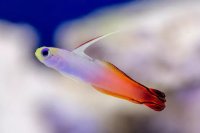
The firefish goby is a slender fish with a distinctive color pattern: a yellow face, a white front half, and a red rear half, with black highlights on the dorsal, anal, and caudal fins. One of its most notable features is the elongated first spine of the dorsal fin, which can be as long as the fish itself. This spine serves dual purposes: it is used for signaling other firefish and acts as a locking mechanism, similar to that of triggerfish, allowing the fish to wedge itself securely into crevices to evade predators. Additionally, the firefish goby possesses a swim bladder, enabling it to hover in place for extended periods with its head pointed upward.
Reef Tank Compatibility and Behavior
Firefish gobies are considered near-perfect reef tank inhabitants because they do not harm corals, other fish, or invertebrates typically found in such setups. They are peaceful and can even serve as "dither fish," whose activity encourages shyer tankmates to venture out. However, they may become territorial in small aquariums, especially with members of their own species. Unless kept as a mated pair, they may quarrel with conspecifics. Suitable tankmates include clownfish, shrimp gobies, and other slow-moving, timid species. Conversely, they are vulnerable to predation by larger fish such as triggers, lionfish, and large angelfish.
Habitat and Care Requirements
Due to their small size, firefish gobies can be kept in nano aquariums, but a larger tank is often recommended because of their darting nature. Strong water flow is essential, and if keeping more than two, provide at least two square feet of bottom surface area per couple. One of the most common causes of loss is jumping out of the tank, so a tightly fitting lid is crucial. Stress, damage from aggressive tankmates, and inadequate nutrition also contribute to mortality.
These fish are timid and will not emerge unless they feel secure. Low to moderate lighting is preferable, as bright light can cause stress. Providing hiding spots is vital; a piece of PVC pipe trimmed and camouflaged with rock can serve as a safe cave, and fine sand or smooth pebble substrate allows them to burrow. When first introduced, they may hide for days, causing owners to worry, but they typically adjust once they feel comfortable.
Diet and Feeding
Firefish gobies are omnivores, requiring a varied diet that includes algae, zooplankton, and meaty foods such as mysis shrimp, brine shrimp, finely chopped seafood, and vitamin-enriched preparations. Because of their small digestive systems, they should be fed two to three times daily to ensure adequate nutrition.
Sexual Differences and Breeding
There are no obvious external differences between genders, though females tend to be smaller and thinner. This species is monogamous, and little is known about its mating habits, though it is presumed to lay eggs on a substrate like other gobies. For breeding, a large tank or a mated pair is recommended.
For hobbyists, the firefish goby offers a rewarding combination of color, hardiness, and personality, provided its specific care needs are met. With proper attention to tank setup, diet, and tankmate selection, this dartfish can be a vibrant and resilient addition to a reef aquarium.